
What is the Cassini INMS Instrument?
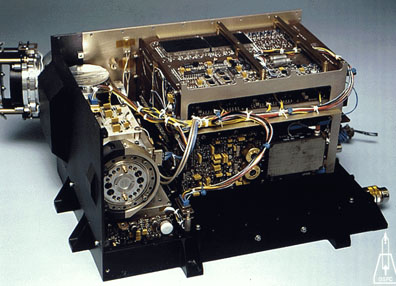
The Ion and Neutral Mass Spectrometer (INMS) is one of the instruments aboard the Cassini orbiter at Saturn. INMS is a quadrupole mass spectrometer designed to collect data to determine the composition and structure of positive ions and neutral particles in the upper atmosphere of Titan and the magnetosphere of Saturn. It is also measuring the positive ion and neutral environments of Saturn's rings and icy moons.
INMS is mounted on the "fields and particles platform" of the Cassini orbiter. It has measured Titan's upper atmosphere above an altitude of 950 kilometers (590 miles) as well as the inner magnetosphere of Saturn.
The INMS instrument was designed, constructed, tested, and calibrated by engineers and scientists at NASA's Goddard Space Flight Center (Planetary Environments Laboratory) and the University of Michigan (Space Physics Research Laboratory).
NASA emeritus scientist Hasso B. Niemann led the Goddard effort, and remains a co-investigator on the instrument. A team of scientists led by J. Hunter Waite, Jr. (Southwest Research Institute, San Antonio, Texas) has continued to work with INMS data and publish scientific findings.
For more detailed information, read the INMS Engineering Technical Write-up.
About Cassini
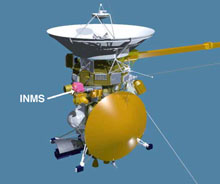
Cassini-Huygens is a mission to the Saturn system. It is a joint mission between NASA's Jet Propulsion Laboratory, which built the Cassini orbiter, and the European Space Agency, which built the Huygens probe. The spacecraft was launched on 15 October 1997, Jupiter flyby was 30 December 2000 and Saturn orbit insertion was 1 July 2004.
The Cassini orbiter is a three-axis stabilized spacecraft with 12 science instruments. Remote sensing instruments include cameras, spectrometers, radar and radio sensors. The fields and particles instruments take in-situ direct sensing measurements of the environment around the spacecraft measuring magnetic fields, neutral and charged particle composition, the composition of dust particles and the properties of plasma waves. Three radioisotope thermo-electric generators provide spacecraft power.
Cassini Orbiter science targets include Saturn and its rings, Titan, Saturn's largest moon. Titan has a substantial atmosphere of nitrogen (N2), methane (CH4), and other hydrocarbons and nitriles. INMS measurements are possible in all of these regions.
The Huygens probe separated from the Cassini orbiter on December 25, 2004, and landed on Titan on January 14, 2005 near the Xanadu region.
For information about the status of INMS, contact:
J.H. Waite, Jr.
Facility Team Leader
Southwest Research Institute
San Antonio, TX
hwaite@swri.edu